
Thread Count for Hotel Sheets: What Hotels Choose and Why
When you specify bedding for a hotel, thread count is one of the first numbers buyers look at, and it is easy to assume a higher figure always means a finer sheet. The reality is more nuanced. The right thread count for hotel sheets depends on your property category, guest expectations, fabric quality, weave, laundry process and budget. This guide explains what the number means, what sheets hotels actually use, and how to choose bedding that stays comfortable and presentable through heavy commercial washing.
Key Takeaways
- T-200 to T-300 covers most hotels,balancing comfort, durability and cost under industrial laundering.
- Weave matters as much as the number:percale feels crisp and cool, sateen feels smooth and silky.
- Fiber quality outweighs a high count:long-staple, single-ply cotton beats an inflated multi-ply number.
- Counts above 600 are often marketing:twisted multi-ply yarns are counted twice and can trap heat.
What Is Thread Count?
Thread count, or TC, is the number of horizontal and vertical threads woven into one square inch of fabric. A pair of 300 thread count sheets, for example, has roughly 150 vertical threads and 150 horizontal threads packed into each square inch. Common hospitality specifications look like this:
- T-200: lightweight, practical and economical.
- T-250: a balance of comfort and durability.
- T-300: softer and denser, suited to premium rooms.
- T-400 and above: often reserved for luxury bedding.
The number is a genuine construction metric, but not a complete measure of quality. Two sheets with the same count can feel entirely different depending on fiber grade, yarn, weave and finishing, so treat TC as one factor among several.
Yarn construction sits behind the number too. Single-ply yarns, spun from one continuous strand of long-staple cotton, produce a cleaner, smoother, stronger sheet than multi-ply yarns twisted from shorter fibers. This is why a moderate, single-ply count often outperforms a much higher multi-ply one, and why hospitality buyers focus on how a sheet is built rather than the headline figure alone.
Which Thread Count Suits Hotel Sheets?
For most properties, T-200 to T-300 is the practical range, widely regarded across the industry as the operational sweet spot for hospitality bedding. The table below maps common ranges to property types:
|
Hotel Type
|
Recommended TC
|
|---|---|
|
Budget and economy
|
T-180 to T-200
|
|
Midscale
|
T-200 to T-250
|
|
Upscale
|
T-250 to T-300
|
|
Luxury
|
T-300 to T-400+
|
The suitable choice follows your operational needs rather than the highest available number. Picking the right specification is about matching it to how the linen will be used and laundered, not chasing a headline figure.
Comparing T-200, T-250 and T-300 Hotel Sheets
Across the T-200 T-250 T-300 hotel sheets range, each step adds density and a slightly more refined hand:
T-200 Sheets
Lightweight, breathable and economical, T-200 sheets suit budget hotels, hostels, serviced apartments and any property that replaces linen frequently. They wash and dry efficiently, which keeps high-turnover laundries moving.
T-250 Sheets
A step up in density and comfort while remaining practical for commercial use, T-250 works well for business hotels, resorts, boutique properties and midscale rooms that want a fuller feel without heavy laundry demands.
T-300 Sheets
With a more substantial, refined feel, T-300 suits upscale hotels, premium rooms and resorts aiming to lift the guest bedding experience, provided the cotton and weave support the higher count.
Percale and Sateen: Choosing the Weave
The hotel bed linen percale vs sateen decision comes down to how the fabric is woven, and it shapes feel as much as the thread count does.
Percale
Percale uses a simple one-over, one-under weave that produces a crisp, cool, matte surface, the classic freshly pressed hotel bed. Its tight structure resists pilling and holds up well through repeated industrial washing, which is why it dominates hospitality bedding, especially for warm climates and properties that value durability and breathability.
Sateen
Sateen uses a four-over, one-under weave that creates a smoother, silkier surface with a subtle sheen and a more luxurious drape. It suits premium rooms, suites and boutique programs, though its more exposed surface can need a little more care under heavy laundering. For everyday hospitality, percale is often the practical pick, with sateen reserved for a softer, more indulgent feel.
What Sheets Do Hotels Use?
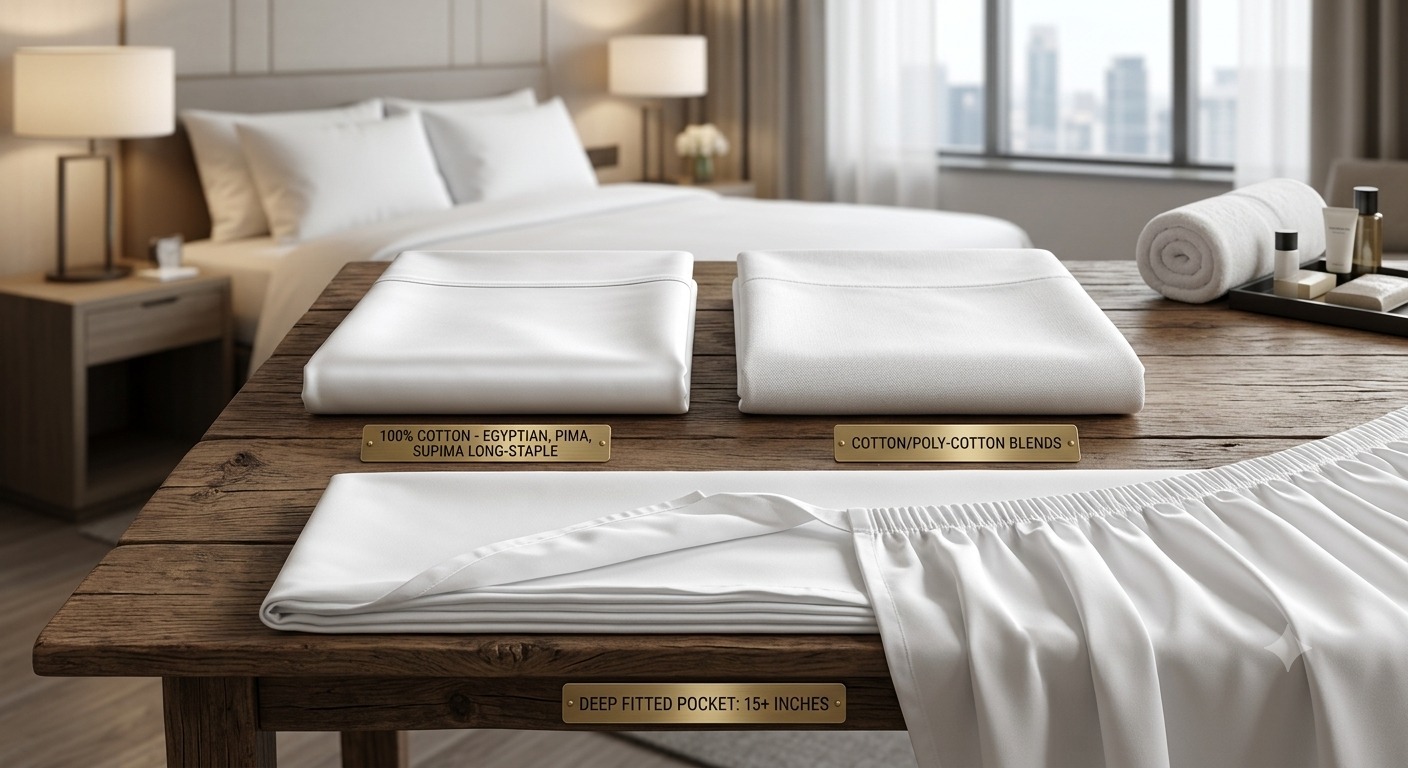
There is no single answer here, because the choice tracks each property’s category, budget and laundry setup. Common options include 100% cotton and cotton or poly-cotton blends, in percale or sateen weaves, across T-200, T-250 and T-300 specifications. High-end properties lean toward long-staple cotton such as Egyptian, Pima or Supima, prized for extra-long fibers that spin into stronger, smoother, longer-lasting yarn. A practical detail many buyers overlook is pocket depth: fitted sheets need deep pockets, often 15 inches or more, to fit thick hospitality mattresses.
Cotton Versus Poly-Cotton Sheets
Weighing cotton vs poly-cotton hotel sheets is another key decision. Pure cotton offers a natural, breathable, comfortable feel that fits upscale and luxury properties where guest comfort leads. Poly-cotton blends cotton with polyester to add durability and easier care, reducing wrinkling, speeding drying and resisting frequent washing. For high-volume laundries, poly-cotton is often the practical, economical choice, while 100% cotton reads as more premium in the room.
Does a Higher Thread Count Mean Finer Sheets?
No. A higher number does not automatically produce a superior sheet, because cotton grade, yarn, weave and finishing all shape performance. This is where the marketing gap appears: counts above roughly 600 are almost always achieved with multi-ply yarns, where two or more thinner strands are twisted together and each is counted separately. A 1,000 TC sheet built from two-ply thread effectively has around 500 single-ply threads, the same as a well-made 500 TC sheet, yet it can trap heat and feel heavy. Rather than asking only which count is highest, ask whether the sheets will hold their comfort and appearance after hundreds of commercial washes.
What Sets Premium Hotel Bedding Apart
Luxury hotel bedding is defined by far more than a big number. Premium sets combine quality long-staple cotton, single-ply construction, a suitable weave, careful finishing and strong stitching for lasting durability. A well-made T-300 or T-400 sheet delivers a genuinely premium guest experience when the materials and construction are built for hospitality, so the aim is a comfortable, elegant bed that still survives regular hotel laundry cycles.
How to Choose Hotel Sheets
Before you place an order, work through a few practical questions:
- Hotel category: match the specification to your property's positioning.
- Guest expectations: premium rooms may call for softer, higher-grade bedding.
- Laundry process: account for washing, drying, ironing and expected wash cycles.
- Fabric composition: weigh cotton against poly-cotton on comfort, durability and cost.
- Weave: choose percale for a crisp feel or sateen for a smoother finish.
- Total cost: consider purchase price, laundry cost and replacement frequency, not just the sticker price.
FAQs
What thread count do hotels use for sheets?
Most hotels use sheets in the T-200 to T-300 range, which balances comfort, breathability and durability under commercial laundering, while upscale and luxury properties may move up to T-300 to T-400.
Is 300 thread count good for hotel sheets?
Yes. A 300 thread count sheet in quality long-staple cotton offers a soft, refined feel that suits upscale and boutique rooms, and many five-star properties choose it for its balance of comfort and durability.
Does a higher thread count mean better sheets?
Not necessarily. Above roughly 600, counts are often inflated with multi-ply yarns, so fiber quality, weave and construction matter more than the number itself.
What is the difference between percale and sateen sheets?
Percale has a crisp, cool, matte feel from a one-over, one-under weave, while sateen has a smoother, silkier surface with a subtle sheen from a four-over, one-under weave.
Are cotton or poly-cotton sheets better for hotels?
Pure cotton feels more breathable and premium, while poly-cotton adds durability, faster drying and wrinkle resistance, making it a practical choice for high-volume laundries.
What thread count do five-star hotels use?
Most luxury hotels stay within roughly T-250 to T-400 in long-staple cotton rather than chasing extreme counts, since very high numbers reduce breathability and durability.
Final Thoughts
So, what is the right thread count for hotel sheets? For most properties, T-200 to T-300 delivers a practical balance of comfort, durability and value, with T-200 suited to economical operations, T-250 a comfortable middle ground and T-300 a step up for upscale rooms. Luxury properties can consider T-300 to T-400 when the cotton and construction justify it. Remember that the number is only part of the picture: fiber quality, weave and finishing decide how a sheet truly feels and lasts. American Linen Towel supplies wholesale hotel, resort and spa bed linen across these specifications, built to balance guest comfort with commercial durability. Request a quote or a free sample and we will help you choose the right sheets for your property.